The problem
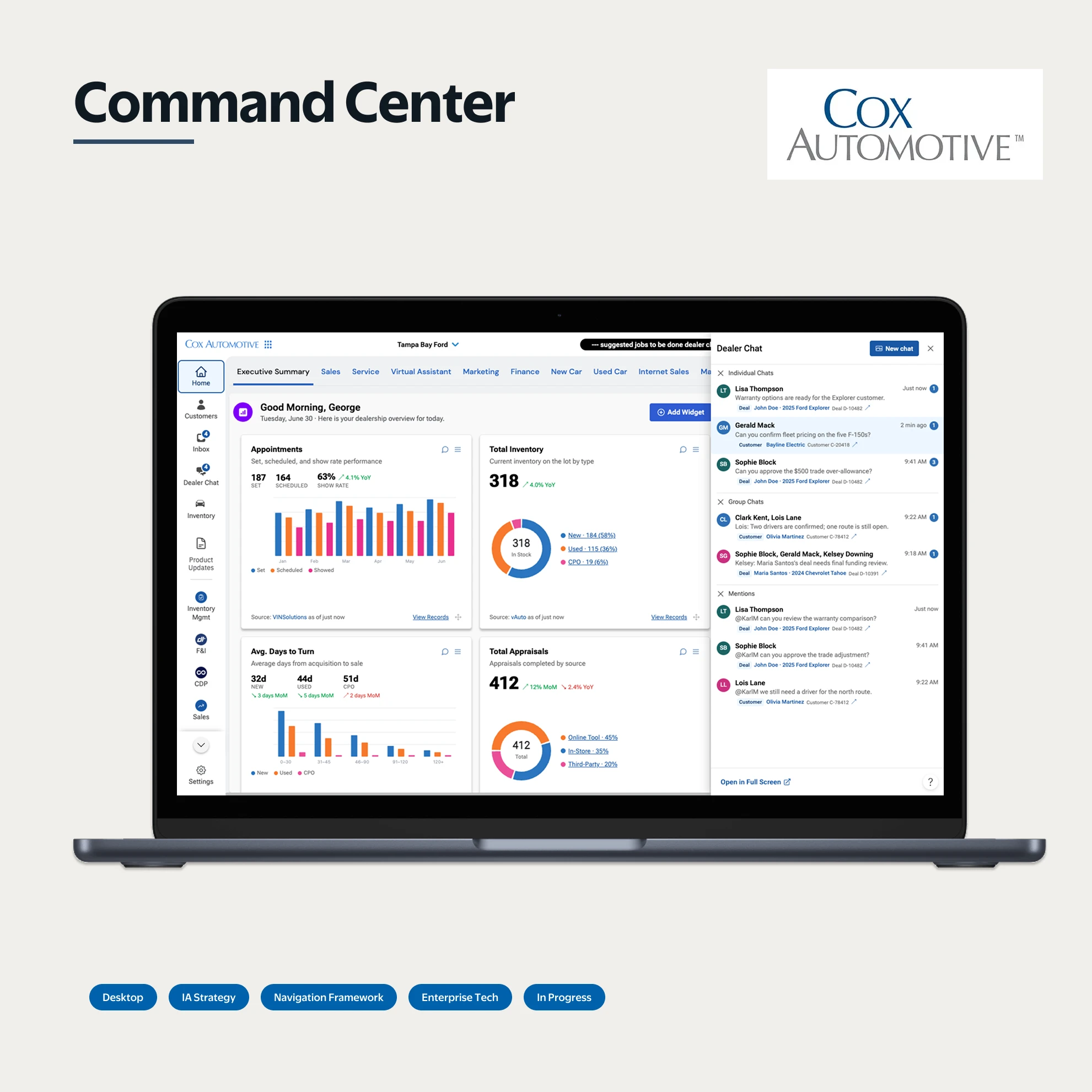
Command Center is the platform 45,000+ dealerships use to manage inventory, operations, and business decisions across the Cox Automotive ecosystem. It had been built feature by feature without a coherent information architecture — which meant that as the product grew, navigation decisions were being made inconsistently, with no shared framework for where things should live or why.
The result: a product that was hard to navigate, hard to reason about, and heading toward NADA with a demo that would expose those gaps publicly. I was brought in mid-project with a clear mandate: define the navigation framework, establish governance for how navigation decisions get made, and build the research foundation to validate it before launch.
"Coming in mid-project and immediately getting up to speed on a complex system — then establishing a framework that the team could actually use — is exactly the kind of strategic lift this required."
Research & discovery
Four weeks from mid-project entry to a fully documented set of core feature requirements. The research question: how do dealership users actually think about their work, and does the current navigation model reflect that mental model?
Key findings
- Users organized tasks by workflow, not by feature category. The existing navigation grouped features the way they were built, not the way they were used. Dealership staff context-switched constantly — the IA needed to support that, not resist it.
- Navigation friction was costing trust. Satisfaction had been tracked, and the gap between what users expected to find and where things actually lived was measurable. The redesign needed to close that gap, not just move things around.
- Decision governance was the missing infrastructure. Feature teams were making navigation choices locally, with no shared framework for consistency. Every new feature added entropy. The IA strategy needed to work as governance, not just as a one-time artifact.
Design process
The navigation framework was designed to answer two questions at once: where does this feature live right now, and where should new features live in the future? Building that in required establishing principles — not just a nav structure — so the team could make consistent decisions without a designer in the room.
Key design decisions
- IA organized around dealer workflows, not feature ownership. The navigation structure was rebuilt around how dealership staff actually move through their day — which cut across the internal team structure but matched how users thought about the product.
- Decision governance documented and socialized. The framework included explicit decision criteria for where new features should be placed. This reduced inconsistency in future navigation decisions and gave product managers a reference they could use without UX involvement in every call.
- NADA as a hard constraint, not a deadline. The demo at NADA wasn't optional. The navigation framework needed to be credible to live dealership audiences — which meant validating the core structure before the event, not after.
- Research validated the framework, not the design. Usability testing was scoped specifically to the navigation model — not the visual design or feature completeness. The goal was confirming the structure held before NADA, not measuring delight.
Outcomes & impact
This work is in progress. The navigation framework shipped at NADA; the governance model is being used to guide ongoing product decisions across the 45,000+ dealership platform.
- Navigation framework delivered and presented at NADA to live dealership audiences
- Decision governance model adopted by product team for ongoing IA decisions
- Reduced inconsistency in how feature teams make navigation placement decisions
- IA foundation in place for active Dealer Chat and feature work continuing post-NADA
Command Center is an active project. This case study reflects the navigation framework and research work completed through NADA. Additional work — including feature design and ongoing IA refinement — is continuing.