The problem
Dealer Chat wasn't a feature request — it was a structural gap. Cox Automotive's Command Center was a platform without a communication layer, and dealership staff had filled that void with personal phones, group texts, and whatever workaround fit the moment. Deals were being managed through text threads with no shared context, no deal-level history, and no visibility for the people who needed it.
The problem wasn't a messaging app — it was that the ecosystem had no model for how internal communication should work. Dealers don't have teams. They don't have channels. The mental models that enterprise collaboration tools are built on don't apply. Building this required working backwards from how dealerships actually function, not forward from Slack.
"The question wasn't what to build. It was how communication should work in an environment that doesn't have the structures we usually design around."
Research & discovery
The research question: how do dealership employees actually communicate to get deals done, and what does that reveal about how a purpose-built tool should work?
Key findings
- Communication was deal-centric, not person-centric. Dealership staff didn't think about messaging as a conversation between people — they thought about it as coordination around a deal, a customer, or a task. The mental model for a Dealer Chat inbox was fundamentally different from any consumer or enterprise messaging product.
- The membership model was the hardest design problem. Traditional messaging apps assume persistent membership — teams and channels that exist outside of any specific workflow. Dealerships don't work that way. Who is in a conversation, and who has visibility into it, depends on role, location, deal stage, and time of day. Defining the membership model was more consequential than designing any screen.
- Subscription reduction was a real constraint. Cox Automotive's ecosystem already included third-party messaging solutions some dealers were paying for. Any new communication feature had to justify the switch — not just be good, but be worth the cost and behavior change.
- Permissions and visibility were safety-critical. In a regulated industry, who sees what in a communication tool isn't a UX preference — it's a compliance question. The permission model had to hold up under audit, not just under normal use.
Design process
Eight core feature requirements defined in four weeks, from a greenfield brief with no direct precedent. The design process was more product strategy than UI — the decisions that mattered were structural, not visual.
Key design decisions
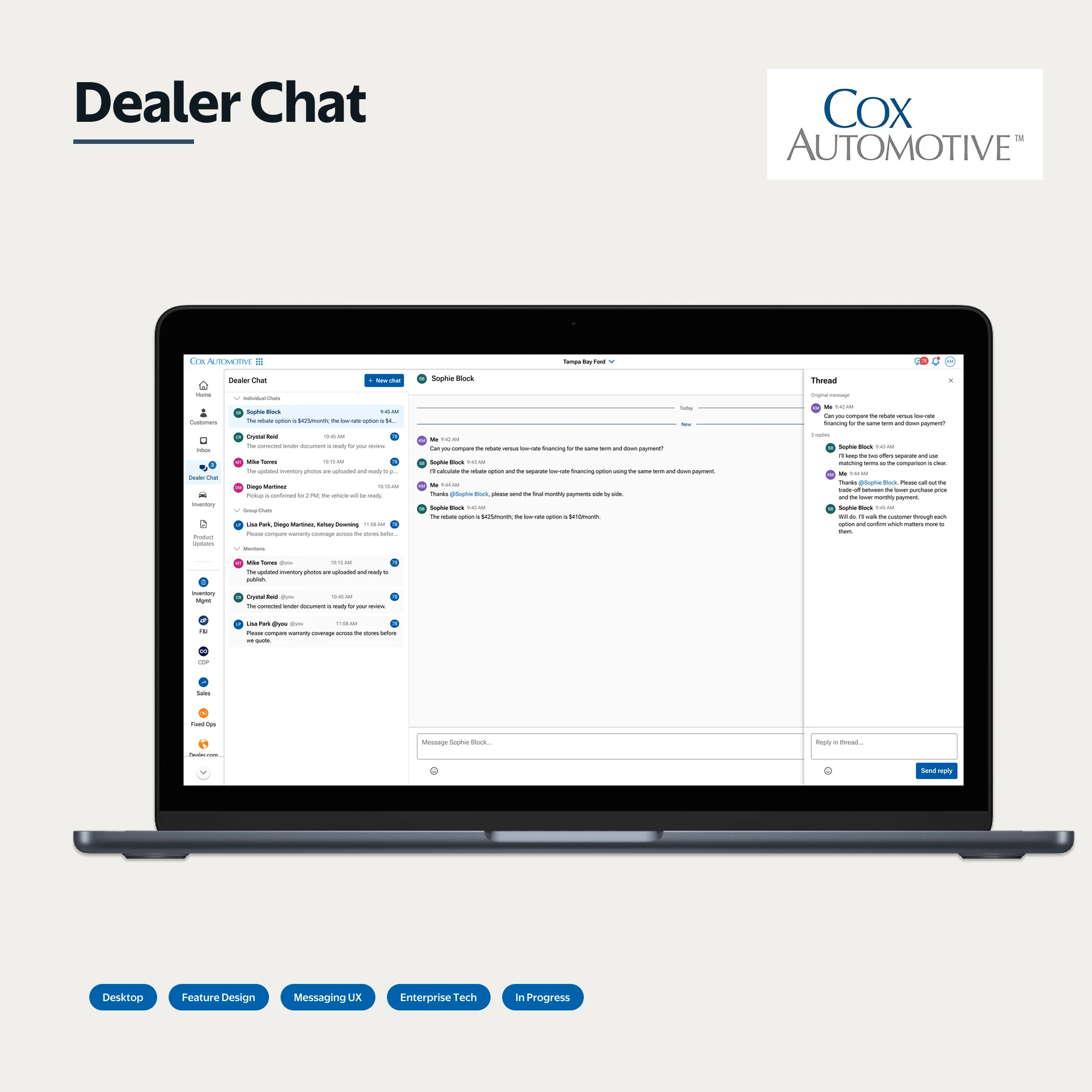
- Deal-first threading model. Rather than building around people or topics, the message structure was anchored to the entities that dealership staff care about — deals, customers, vehicles. This meant conversations carried context without anyone having to re-establish it.
- Explicit membership over ambient presence. Because dealerships don't have persistent teams, participation in a conversation required explicit assignment. This made permissions auditable and made the communication model legible to people unfamiliar with enterprise chat tools.
- Individual and group chat with a unified inbox. Dealers needed both direct messaging and group coordination, but wanted a single place to track everything. The unified inbox organized messages by deal and urgency, not by recency — matching how dealership staff actually prioritize their day.
- MVP scope held at 8 requirements. The brief started with far more. Research-backed prioritization reduced the MVP to the features that addressed the core workflows, with everything else deferred until the membership model was validated at scale.
Outcomes & impact
This work is in progress. The core feature set is defined; the product is in active development across the 45,000+ dealership platform.
- Communication effectiveness score: 6.25 / 7
- Satisfaction improvement: 4.3 → 5.8 / 7
- 8 core feature requirements defined in 4 weeks from a greenfield brief
- Membership model and permission framework adopted as the foundation for the build
- Product strategy positions Dealer Chat as a replacement for dealer-paid third-party subscriptions
Dealer Chat is an active product. This case study reflects the research, product strategy, and design framework work completed through the MVP definition phase.