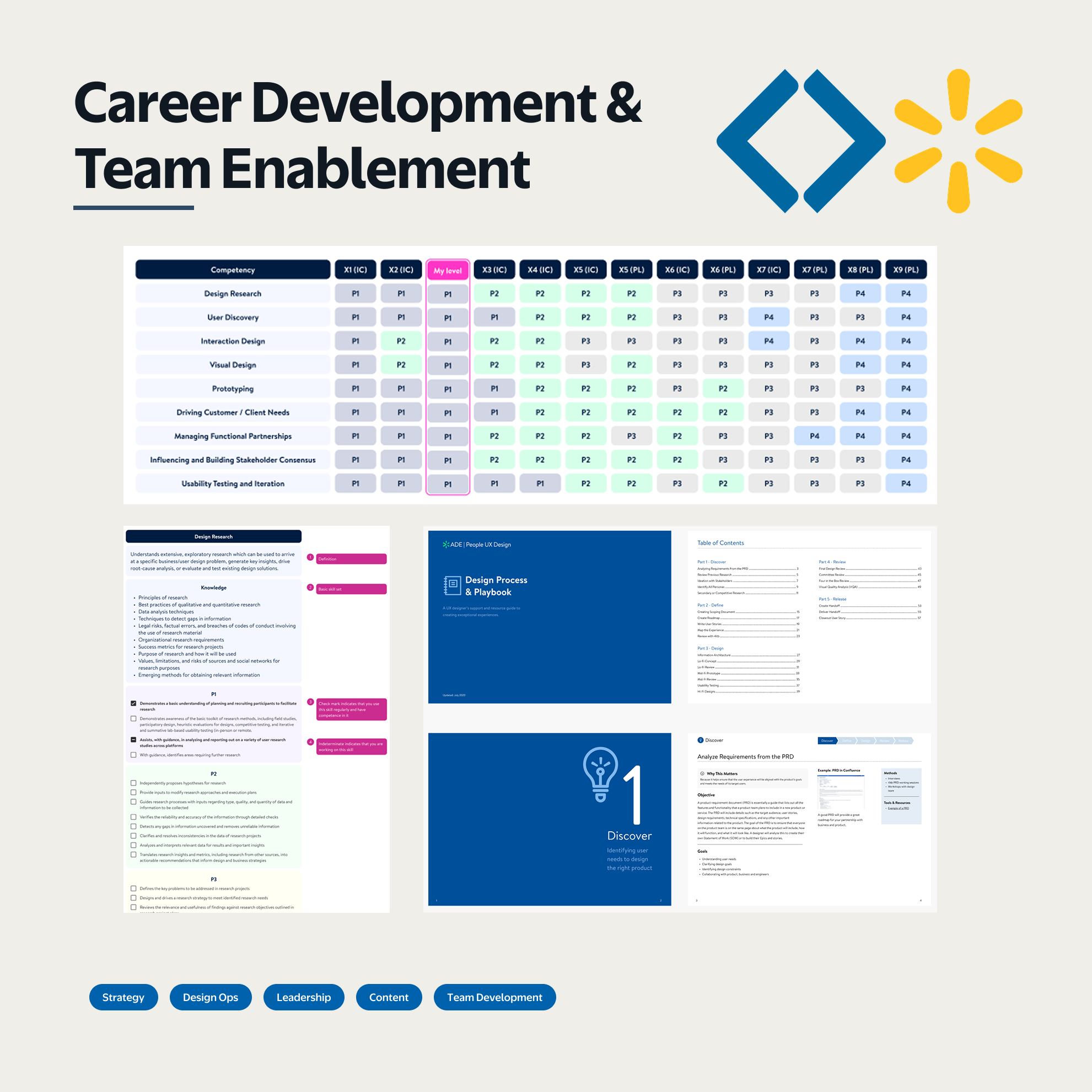
Strong design teams don't happen by accident — the infrastructure has to be built. At Walmart, the org had deprioritized it for product delivery: no shared competency framework, inconsistent onboarding, no structured way to give or receive career development feedback. I built it because I could see what was missing and what it was costing the team. Treated team enablement as a design problem: real users, real constraints (limited time alongside product work), clear outcome.
What I built: competency frameworks grounded in the actual work our team did (adopted across the UX org for performance conversations and career planning), a process playbook codifying how we worked from discovery through handoff, structured onboarding resources, 1:1 coaching frameworks for designers at multiple levels, intern mentorship through a full project cycle, and AES committee work driving competency metrics across UX, PM, and PMO functions at the org level.
9.25 / 10
Peer recommendation score · 2026 360° assessment · Sam's Club · Senior UX Designer
"Tracy is ready to lead a team formally, because she's been doing it informally for as long as I've known her. Whoever gets to work for her is going to be lucky."
Juan Peña, Senior UX Designer, Walmart Global Tech
University of Arkansas UX Workforce Program
In 2026, the University of Arkansas brought me in as the subject matter expert for their UX workforce development program. The curriculum needed a full rewrite — the existing material didn't reflect how design actually works today, and it didn't account for what entering the field looks like in the age of AI.
I rewrote the curriculum around two foundations: design thinking and practice built on real principles, and Figma as the tool students use to develop and present that work. The course is self-directed, culminating in a portfolio each student builds through the program. I'm responsible for portfolio review and feedback at the end — which means I'm the person who defines what good looks like for designers entering the field from this program.
The course launches October 2026.
At Walmart, team enablement went from deprioritized to infrastructure — frameworks and coaching that became the standard for performance conversations and career planning across three functions. At the University of Arkansas, the curriculum shifted from outdated to current: design foundations and portfolio practice rebuilt for how the field actually works now. In both cases, the work was the same — define what good looks like, build the system that gets people there, and be accountable for the outcome.